

Email:
mobileradiators@hotmail.com
Servicing Greater Brisbane
Call Gavin
If your car is overheating or losing coolant, the safest move is to stop driving and have a mobile mechanic come to you, because every extra kilometre risks the engine. That is the whole case for emergency radiator repair at the roadside: the fix travels, and your damaged car doesn’t.
Picture a 42°C afternoon on the way home from work. The air conditioning feels weak and the temperature gauge creeps past its middle mark. Then a wisp of steam rises from the bonnet. You can keep driving and hope, or you can pull over and get help where you stopped.
Australia’s heat makes this scene common. Summer 2025 ended the country’s fourth-hottest year on record, and January 2026 was its fourth-hottest January. During that month, six consecutive days saw at least one Australian location reach 49°C or higher. A stressed cooling system has little margin left in temperatures like these.
Gavin brings radiator diagnosis and repair to wherever your car is parked. You skip the tow truck, and you skip the risk of driving a hot engine to a workshop. In heat this extreme, a small coolant leak can become a stranded car within one trip, so treat the first warning as the emergency.
A temperature gauge climbing past its usual midpoint is the earliest and clearest warning you will get. Most engines sit at a steady operating temperature, so any rise on a normal drive means the cooling system is falling behind. Your nose, your eyes and the cabin heater add clues.
These warning signs often show up together, and one alone is still reason to slow down and check:
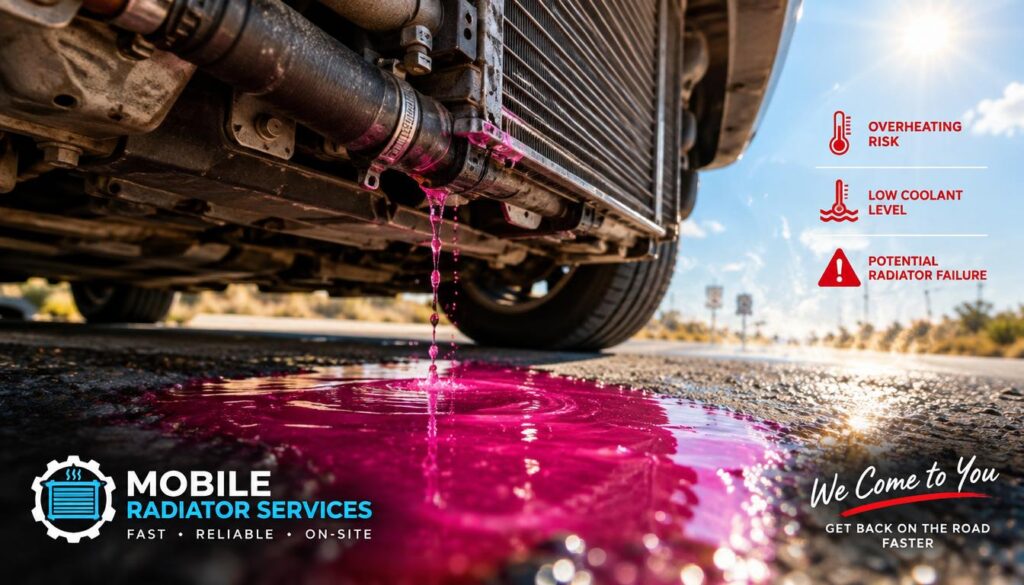
White smoke with a sweet smell deserves extra attention. It suggests coolant is entering the combustion chamber, often through a head gasket fault. Overheating like this can turn a modest repair into a major one quickly.
Pull over as soon as it is safe and turn the engine off. Allow at least 15 minutes for it to cool before you check coolant. Driving while the temperature gauge is too high can damage the engine and add to your repair costs.
Never open a hot radiator cap, even when the steam has stopped. Pressurised coolant can erupt and cause severe burns.
Once the engine has cooled, look at the reservoir. If the coolant sits at maximum with no visible leaks, you may continue while you watch the gauge closely. If in doubt, call for help. Emergency radiator repair near Sydney NSW, like anywhere else, starts with the car parked safely and the engine off. The steps for a gauge spike on a busy motorway follow the same order.
Keep a cloth and drinking water in the car through summer, so you can wait out the 15-minute cool-down in safety.
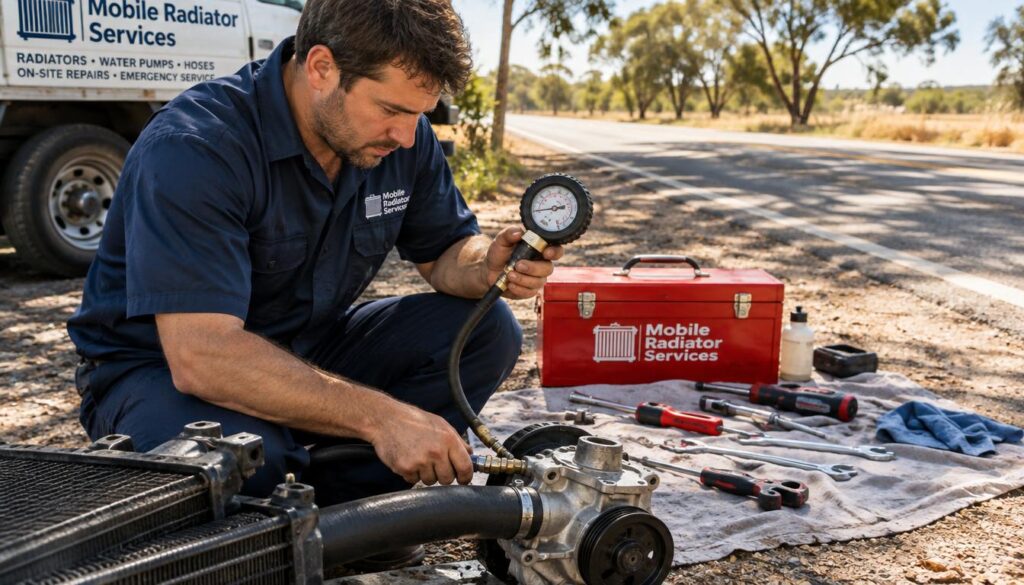
The first job on site is finding the real leak, because a wet radiator is often fed by a hose or the water pump. Pressure testing means pressurising the cooling system with a hand pump to find exactly where coolant escapes, including leaks too small to see. The test covers the radiator, every hose, the thermostat housing and the water pump.
Corrosion is the leading cause of radiator leaks, so the mechanic also checks tanks and seams for weakness. Emergency radiator repairs near me and emergency radiator repair near Melbourne VIC both mean the same thing: the mechanic works where your car stands, with quality parts on hand.
Fixing a cracked radiator is worth it only when the crack is small and accessible. Plastic radiators generally last around 8-10 years, depending on coolant quality, servicing and heat stress. A radiator near that age is usually better replaced, since radiator repairs on old plastic rarely hold.
| Situation | Usual call | Reason |
|---|---|---|
| Small accessible crack | Repair | May reopen with heat cycles |
| Crack over 50 mm | Replace | Too large to hold |
| Branching crack | Replace | Spreads |
| Crack near hose neck, seam or mount | Replace | Under stress |
| Brittle plastic with hairline fractures | Replace | More cracks follow |
Emergency radiator repair cost depends on your vehicle and the parts it needs. A radiator for a popular car may cost a few hundred dollars for the part. Prestige or performance models can top $1,000 before labour.
A replacement involves draining the coolant and removing the radiator and related components. The new unit is fitted, the system is refilled and bled, then the car is road-tested to rule out further engine damage. Ask whether the quote covers refilling and bleeding the system, since an air pocket left behind can overheat the engine again.
A temporary fix buys you days or weeks, never a sound radiator. You can patch a leaking radiator temporarily with epoxy or fibreglass. These repairs may last weeks or months, but they are not guaranteed to survive daily heat and pressure.
To temporarily fix a cracked radiator, apply epoxy to a clean, dry surface only as a bridge to a proper repair. A stop-leak additive may seal or slow a small pinhole. It often fails on larger leaks or water-pump or head-gasket leaks.
Never add a second bottle of stop-leak. Overuse can clog the radiator or heater core and cut cooling efficiency.
Emergency radiator repair in Brisbane heat calls for a permanent fix within days, not weeks, because the engine system works hardest there. Tell your mechanic about any stop-leak you used, because it changes how the system must be flushed.
Stopping at the first sign of overheating is the single choice that saves the most money. A small leak caught early is often a hose or a cap. The same leak driven on can cost you an engine.
Good car cooling also depends on routine care. A well-maintained radiator can last 8 to 10 years, and replacing coolant at your manufacturer’s recommended intervals extends its life. Add a coolant change to your next car service if one is due.
If you need help now, there is no need to book radiator work at a workshop and wait for a tow. Gavin’s emergency service brings the tools to the roadside, the car park or your driveway. He’ll come to you!
Call Gavin on 0401 622 996 from wherever your car is, and he’ll come to you.


Privacy Policy | Terms and Conditions