

Email:
mobileradiators@hotmail.com
Servicing Greater Brisbane
Call Gavin
Your gauge hits red on the Ipswich Motorway on a Monday, and you need a mobile radiator repair fast. Or you walk out at home and find a green puddle under the front of the car. Either way, someone can fix it where it sits, the same day.
We come to you: your home driveway, your workplace car park, or the roadside where the vehicle stopped. That means no tow truck and no driving a hot engine across town to a shop. The vehicle stays put, and the work happens around it.
First, switch the engine off and leave the hot radiator cap alone. The cooling system sits under pressure, and the coolant inside scalds skin in a second. Mobile Radiator Services has been on the road since 1986, more than 35 years of overheating call-outs.
Gavin answers the phone on 0401 622 996, and most of the fix happens at the kerb. Only one job, the re-core, has to go back to the workshop.
Nearly every radiator job, from a split hose to a full replacement, gets done in your driveway. Only a re-core goes back to the workshop at Chandler. A mobile radiator repair covers all radiators, radiator repairs and the mechanical work that goes with them, like water pumps and thermostats.
Mobile radiator repairs in Brisbane take in cars, 4x4s, SUVs, light trucks and light commercial vehicles. We also fix tractors, ride-on mowers and generators, which cannot be driven to a shop at all. Mobile Radiator Services is an ADRAD radiator specialist, so an ADRAD unit is our normal fit.
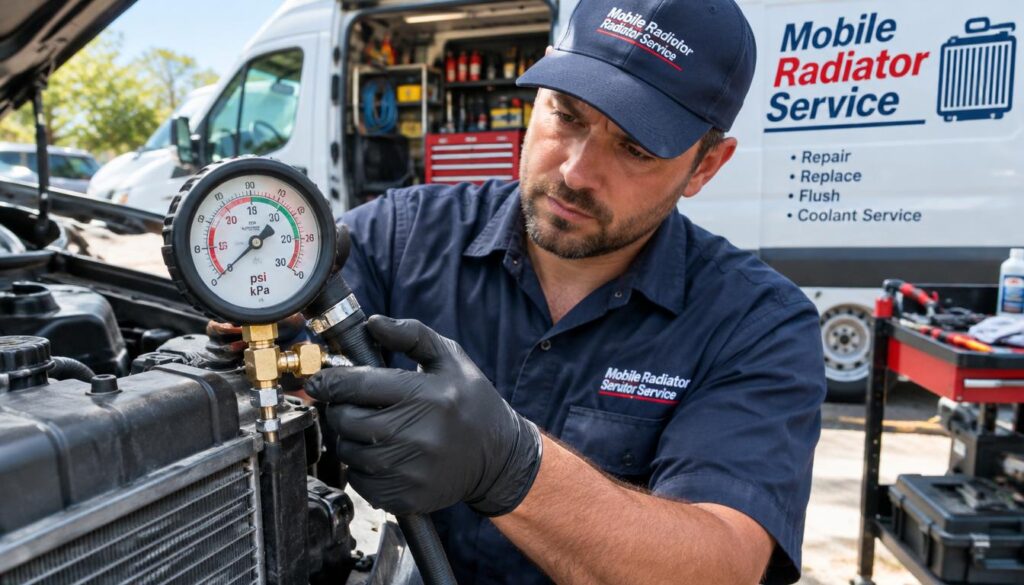
A pressure test pumps the cooling system up to its normal working pressure with the engine off. Any leak in the radiator, hoses or tanks then shows itself before we touch a spanner. It finds weeping core tubes, cracked plastic tanks, split hoses, a loose clamp or a tired radiator cap.
Most of those leaks get fixed on the spot with the parts on board. A cracked plastic tank is the one we do not patch, because plastic that has split once will split again. That radiator gets replaced instead.
One kind of overheating is not a radiator job at all. A vehicle that has been run dry and warped the cylinder head needs engine work. We will tell you that straight rather than fit a radiator that will not stop the overheating.
If the engine has been run dry and the head has warped, a new radiator will not fix it. We would rather say so than sell you a part that cannot work.
A replacement radiator is a fully new unit, and for most vehicles that means an ADRAD unit. A re-cored radiator keeps the original brass or copper tanks and gets a new core fitted between them. We favour a re-core for older and classic vehicles where no new unit exists.
Re-coring is workshop work, since the tanks come off and the new core goes in on the bench. We remove the radiator at your place, take it to Chandler, and refit it once it is done. The fitting itself, like every other job here, happens on site.
A coolant flush and clean-out clears a blocked or muddy system so coolant moves through the core again. We flush the heater box at the same time, because the heater core clogs just like the radiator. A tractor or generator that has sat in dust for years often needs exactly this.
Top and bottom hoses perish from the inside, so we carry replacements and swap them on the spot. A thermostat that sticks shut or a cap that no longer holds pressure gets replaced in the same visit. Both take minutes with the part on board, with no second call-out.
What your vehicle is doing right now tells us which of these jobs it needs. The signs are easy to read once you know what each one means.
A modern engine can suffer head damage within minutes of running with the gauge in the red. Aluminium heads warp fast once the coolant stops carrying heat away. So the first question with any cooling system problem is not what is wrong, but whether to stop now.
Here are the five signs we hear about most, with the likely cause and whether you can keep driving. When in doubt, pull over and switch off. Our guide to emergency radiator repair and the drive-or-call decision walks through that choice in more detail.
| Sign | Likely cause | Keep driving or stop |
|---|---|---|
| Temperature gauge climbing or red warning light | Low coolant, stuck thermostat or blocked core | Stop now |
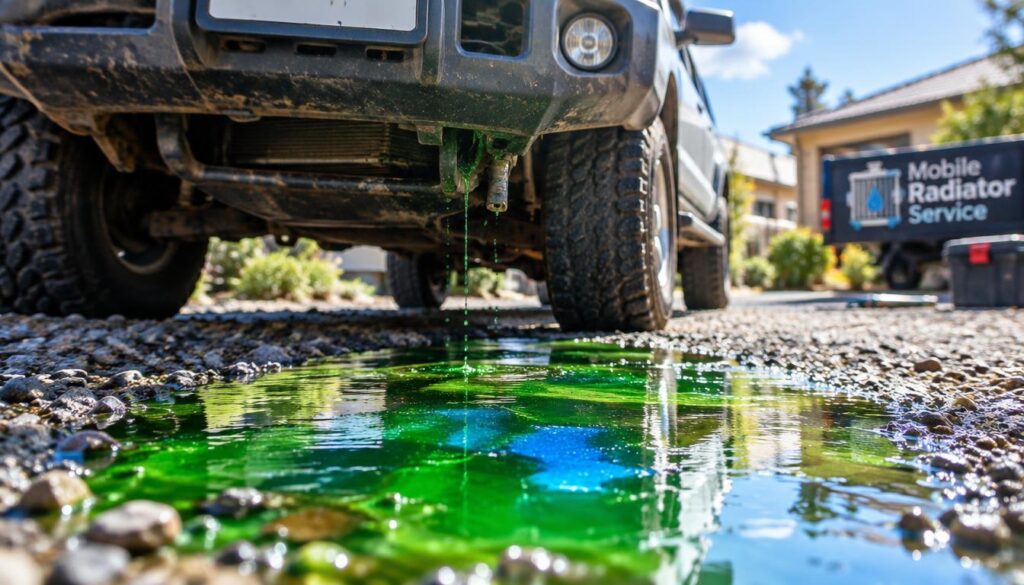
| Coloured puddle (green, orange or pink) under the front | Leaking tank, core or hose | Short trip only, top up with water first |
| Sweet smell or white steam from the bonnet | Coolant hitting the hot engine | Stop now |
| Heater blowing cold while the engine is hot | Low coolant or air lock | Book within days |
| Rusty or muddy coolant in the overflow bottle | Blocked, corroded system | Book a flush soon |
Topping up with plain water is fine to get home in a Queensland summer. Water boils sooner than coolant, so a proper coolant mix must go back in once the leak is fixed. Keep a two-litre bottle of water in the boot from November to March.
Two problems hide behind ordinary-looking overheating. A vehicle that keeps needing a top-up with no puddle underneath may be losing coolant into the engine. That is a head gasket symptom, so mention it when you book, because it changes what we bring.
The second is overheating in stop-start traffic but not on the highway. That pattern points to a fan or airflow problem rather than the radiator core. Highway speed pushes air through the core on its own, and traffic does not.
Rusty coolant tells its own story, too. Brown or muddy liquid in the overflow bottle means the core is corroding from the inside and will block in time. A flush soon beats a new radiator later.
Leaks you can see are the easy ones. Small weeps at a hose joint often only show under pressure, which is why we test before we quote. Once you know your sign, the visit runs to a set pattern from the first call to handover.
You ring at 8 in the morning about a Hilux dripping coolant in the work car park. The technician arrives with a radiator on board, and the job is usually finished the same day. That is the normal shape of a service call, and it runs in five steps.
Have a few things ready before we arrive: the keys, a flat spot to park, and clear access to the bonnet. If a flush is on the cards, a garden hose or a bucket of water nearby saves time. We carry replacement radiators, hoses, clamps and coolant in the vehicle, so most parts are already on board.
A replacement radiator for an older or unusual vehicle gets sourced on the day. It can be delivered within a few hours of your call, so the work still finishes on the spot. Gavin tells you on the phone whether your model is on board or needs sourcing.
Firm level ground matters more than people expect. The system drains, fills and bleeds properly only when the vehicle sits level. A car stopped on a soft verge or a steep driveway may need rolling a few metres first.
The quote comes after the pressure test and before any work, so the number reflects what we found, not a guess. Time on the spot runs from under an hour for a hose to a few hours for a replacement. What shapes the number on that quote is the vehicle and the fault, and both are simple to explain.
The price depends on the vehicle and the fault. That is why the quote comes after the pressure test and before the work, never as a phone guess. Our pricing is competitive, and nothing gets done until you have agreed to the number.
Four jobs cover most call-outs, and the line between repair and replace is what moves the cost most. Time on site is the other factor, since labour is part of every quote.
| Job | What it fixes | Typical time on site | Repair or replace |
|---|---|---|---|
| Hose or clamp replacement | Split or perished hose, leak at a joint | Under an hour | Repair |
| Coolant flush and clean-out | Blocked or muddy system, poor heater | About an hour | Repair |
| Re-cored radiator | Leaking core in a brass or copper radiator, classic vehicles | Removed on site, refitted after workshop work, usually a day | Repair |
| Replacement radiator | Cracked plastic tank, corroded core, radiator past repair | 2-3 hours | Replace |
Repair is cheaper when the fault is a hose, clamp, cap or a single small leak in a metal core. Replacement wins when the plastic tanks are cracked or the core is corroded in several places. A common model is often a replace job too, because a new unit costs little more than patching an old one.
The mobile radiator repair cost moves with four things. The vehicle comes first: a Corolla radiator costs less than a LandCruiser or light truck unit. Then comes whether you need a re-core or a new unit, and how much coolant the system takes.
Doing a thermostat, hoses or water pump in the same visit adds parts but saves a second call-out. A cheap unbranded radiator on a vehicle that tows a caravan usually costs more within two years. Thin cores and plastic tanks fail early under load and in summer heat, so quality parts pay for themselves.
ADRAD radiators carry up to a 5-year warranty, and we fit them where a unit exists for your vehicle. Ask any provider three things before you say yes. How long does the warranty on the part run, is labour covered, and does driving the vehicle hot void it?
The answers tell you a lot about the workmanship behind the quote. A provider who stands behind the fit will put the terms in writing. A quote is always given on 0401 622 996 before work starts, and that includes the warranty term.
Once you know what drives the number, the only question left is whether we can reach your street, and when. The answer for most of south-east Queensland is yes.
If your vehicle is anywhere from Sandgate to Redland Bay to Ipswich to Ormeau, we come to you. Our mobile services cover Greater Brisbane, Ipswich, the northern Gold Coast and the Moreton Bay region. Five groups cover most of the road we drive, with example suburbs in each.
Mobile radiator repairs on the Gold Coast cover the northern end around Ormeau. Your car gets fixed at home or at work rather than driven down to a shop. Radiator repairs in Ipswich take in Goodna, Redbank and Springfield as well as Ipswich itself.
Customers outside those areas, such as the Sunshine Coast or the southern Gold Coast, should still ring. A job can sometimes fit around a nearby booking, though we cannot promise it. Tell Gavin the suburb and he will say straight away whether it works.
We do not offer 24 hour mobile radiator repair. The team works Monday to Friday, 8:00am to 5:00pm, and is closed on weekends and public holidays. A vehicle that fails on a Saturday should be parked, not driven, until Monday.
If the vehicle fails on a Saturday, park it and leave it until Monday. A weekend of sitting still costs nothing, and a weekend of driving hot can cost an engine.
The workshop at Chandler handles re-cores and air conditioning work, so some jobs end with a trip there. Booking is by phone to Gavin on 0401 622 996 or by email to mobileradiators@hotmail.com, under ABN 28 112 062 996. Phone gets a faster same-week slot, and wherever your driveway is, we come to you.
Keep two things in mind before you dial, and the rest is one phone call.
A radiator job done in your driveway today is cheaper than an engine rebuild next month. A hot engine gets switched off, not nursed home, because an overheated engine costs far more than any radiator. Water in the boot helps you get home, but only once the gauge has dropped.
Second, most repairs on vehicles of every size happen right where they sit, with a quote agreed first. Call Gavin between 8:00am and 5:00pm on a weekday. Tell us where the vehicle is and what it is doing, and we come to you.
Utes, 4x4s, light trucks and ride-on mowers all get the same visit. Gavin’s number is 0401 622 996.


Privacy Policy | Terms and Conditions